Navigating Outdoors
Navigation is the art of getting from one place to another. It’s about making a plan around how to get from place A to place B, and then actually getting from A to B.
While navigation may seem like a big and scary topic, everyone can navigate! Think about it: every morning you get up, navigate from the bedroom to the bathroom and then out the front door. Navigating in the bush is the same, it’s just a little more complex. Learning to navigate around your house just means learning a few routes and remembering them. But in the bush, navigation involves working out and following a new route each time, and the landmarks are unfamiliar. There’s also more pressure to get it right on a bushwalk because getting lost in the bush is a bigger deal than getting lost in your hallway!
Navigation is a skill acquired by experience, study, and observation. It takes a long time to master. When starting out, it’s easy to be wrong. Unfortunately, the only way to get better is to persevere and keep on going! Navigation is a fun skill to learn, and many bushwalkers find that learning to navigate gives them a whole new appreciation of the landscape.
How to ...
A Beginner’s Guide To Map & Compass Navigation
Finding your way doesn’t have to be scary! Zac, from We are Explorers, has put together a beginner’s guide to navigating with a map and compass so you can get out there (and back) without a worry.
Source: We Are Explorers
This manual provides guidelines and information for safe and enjoyable community-based bushwalking across Australia.
Section: Practical Navigation
- Map and compass basics
- Navigation Techniques
- Navigation in difficult conditions
- Mobile phone navigation
- Handheld GPS navigation
- GPS sports watches
Source: Bushwalking Victoria
3 Basic Compass Skills Everyone Should Learn
Advances in GPS technology are no replacement for basic navigation skills.
With the advent of GPS technology, navigating by compass is a skill that seems to be rapidly falling by the wayside. Because a GPS unit is only as good as the battery or satellite signal that guides it, your ability to determine location and direction by compass is as important as it ever was. Even if you never need to use classic orienteering techniques, becoming proficient with a compass is a process that puts you into even closer contact with the outdoors. The basics can be broken down into three categories:
- Setting the Declination
- From Map to Field
- From Field to Map
Source: Pocket
Orientate yourself with a compass
Using a map and compass may seem antiquated but it could save your life. So when traveling in the backcountry it is always a good idea to carry a map and a compass with you even if you have a GPS device. But they are only good if you know how to use them!
Source: Suunto
Technology
Personal Locator Beacons (PLB)
Personal locator beacons (PLBs) are devices that transmit your location via satellite to emergency services. They are used in life-threatening situations to signal that emergency help is required (e.g. group is lost, someone is injured or very unwell), and usually only activate when other forms of two-way communication such as a phone call cannot be made (e.g. group is out of mobile phone reception).
PLB’s are lightweight, small and practical, suitable for bushwalkers to carry on their person. They are an important safety backup for groups traveling through areas with poor or no mobile phone reception, and have been proven time and time again to be a life-saving device for bushwalkers. (Source: National Parks Association of NSW)

Useful Resources
Infographic
Distress Beacons (Australian Maritime Safety Authority)
Personal Locator Beacons (National Parks Association of NSW)
Is it an EPIRB or a PLB? (WILD Magazine)
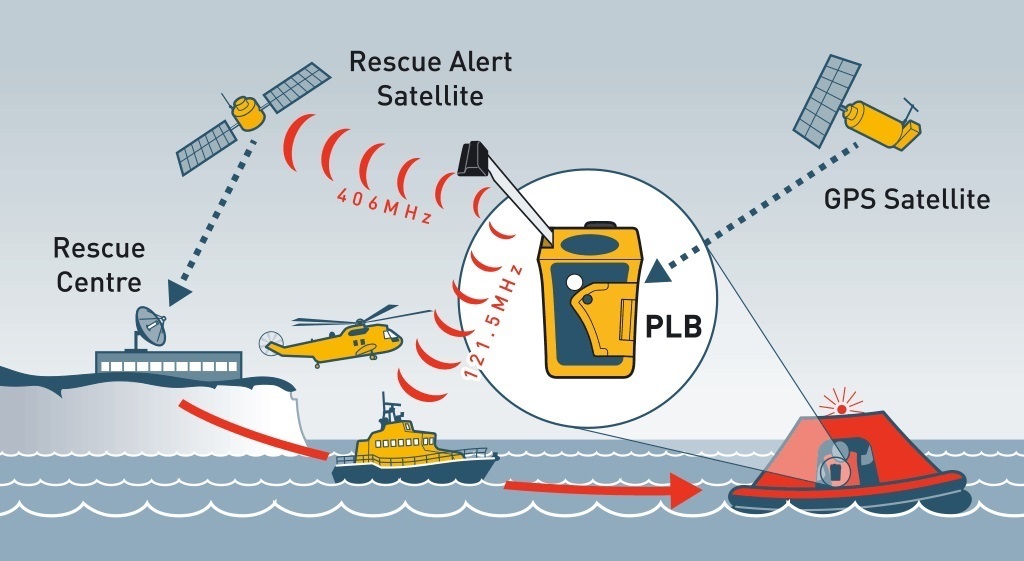
Confused? This is what’s happening in this image.
Everything You Need to Know About Off-Grid Safety
Personal Locator Beacons (PLBs) are that one thing all hikers should carry, but very few do. Not sure what a PLB even is? This WE ARE EXPLORERS comprehensive guide to PLBs and Satellite Messengers will help; how they work, and why you need one on your next adventure.
What is a PLB?
A Personal Locator Beacon (PLB) is a device you carry with you and can activate in case of a life-threatening emergency. PLBs don’t require cellular reception to work. Once activated, they connect with emergency services who are deployed to your location.
When should I carry a PLB?
In summary, always carry a PLB if you’re undertaking an adventure in which any one of the following applies:
- There’ll be no reception
- The activity is high risk (snow, heat, cliffs and drops, solo trips)
- The potential outcomes are likely to be critical and time-sensitive
- It’s an extended trip and people may not raise the alarm for many days or weeks
- Self-rescue would be impossible, or no-one is likely to bump into you or send for help if needed.
READ MORE (We are Explorers)
Using a mobile phone or handheld GPS for bush navigation.
- Where to from here?
- Reading a topographic map
- Preparing for a trip
- Mobile phone Map App, or a handheld GPS?
- Why use a mobile phone?
- Which Map App?
- Why use a handheld GPS?
- Which GPS model?
- GPS device and Map App settings
- *UTM Grid References 14 figure, 6 figure.
- Learning to use handheld GPS or Map App
- Some basics
- Backup
- No technical detail or instructions
- References and external links
- GPS watch
Source: Bushwalking Manual
How to Videos
Learn to navigate ...
Organisations
Useful Links & Resources
Related Articles
Recommend a Resource
Let us know by Recommending a Resource