Gemini
How to Prepare Your Trailer
Published: 12 November 2026
How to Prepare Your Trailer for Outdoor Adventures and Camping Trips in Queensland
Queensland has plenty to offer anyone who enjoys getting outdoors. Whether it’s a weekend camping trip in the Sunshine Coast hinterland, a family getaway to the Scenic Rim or a longer adventure through regional Queensland, there’s no shortage of places worth exploring.
But packing for an outdoor trip isn’t always straightforward. Once you add tents, camping chairs, eskies, cooking equipment and other essentials, your vehicle can quickly run out of space. That’s where a trailer can come in handy.
While towing a trailer makes transporting bulky equipment more convenient, it also requires proper preparation. Worn tyres, unsecured loads or incorrect weight distribution can create serious problems on the road.
Before heading off on your next outdoor adventure, here are some practical steps to help you prepare your trailer and travel more safely.
Not every trailer is suitable for every journey. Before packing your camping equipment, consider where you’re travelling, what you’ll be carrying and the types of roads you’ll encounter.
For example, a standard box or cage trailer may be suitable for transporting camping gear to established campgrounds with appropriate road access. However, that doesn’t necessarily mean it’s designed for rough tracks or off-road conditions.
Think about the following before your trip:
- How much camping equipment will you be transporting?
- Will you be travelling on sealed or unsealed roads?
- Does your destination allow trailer access?
- Is your trailer designed for the conditions you’ll encounter?
- Can your towing vehicle safely handle the loaded trailer?
Always check the trailer manufacturer’s recommendations and any restrictions that apply to your planned route.
Choosing suitable equipment from the beginning can help prevent unnecessary complications later.
One of the most important parts of safe trailer towing is knowing how much weight your vehicle and trailer can handle.
Every towing vehicle has manufacturer-specified limits, and exceeding them can affect handling, braking and overall safety.
You’ll often come across these three trailer weight terms:
Tare Mass: The empty trailer’s mass, as specified by the manufacturer.
Aggregate Trailer Mass (ATM): The maximum permitted mass of the fully loaded trailer when it is not connected to the towing vehicle.
Gross Trailer Mass (GTM): The mass supported by the trailer’s wheels when the loaded trailer is coupled to the towing vehicle.
You also need to consider your vehicle’s Gross Vehicle Mass (GVM), Gross Combination Mass (GCM), towbar rating and permitted towball download.
Remember that passengers, luggage and equipment inside your vehicle contribute to its overall loaded weight.
Before leaving, check the relevant specifications and make sure your vehicle and trailer combination remains within all applicable limits.
If you’re unsure about the actual loaded weight, consider using a public weighbridge.
A trailer that hasn’t been used for several months may need additional attention before a long trip.
Even if everything looks fine from a distance, small mechanical problems can become serious once you’re travelling at highway speeds.
Start by inspecting the tyres.
Look for visible cracks, uneven wear or other damage. Check tyre pressures when cold, following the manufacturer’s recommendations, and inspect the spare tyre if you carry one.
Next, check the coupling, safety chains and electrical connections.
Make sure the coupling is properly fitted and locked onto the towball, and confirm that the safety chains are correctly attached using appropriate fittings.
Test the indicators, brake lights, tail lights and number plate light.
If your trailer has brakes, check that they operate correctly and are maintained according to the manufacturer’s instructions.
Pay attention to wheel bearings, suspension components and any unusual movement or noises.
If something doesn’t seem right, arrange an inspection before travelling rather than hoping the problem will resolve itself.
Packing a trailer involves more than finding enough room for everything.
How you position your equipment affects the trailer’s balance and how it behaves while towing.
As a general principle, heavier items should be positioned low and appropriately around the axle area, with the final placement maintaining suitable towball download.
Avoid concentrating excessive weight at the rear of the trailer. Insufficient towball download can contribute to instability and trailer sway.
Too much weight towards the front can also overload the towbar or place excessive load on the towing vehicle.
Follow the trailer manufacturer’s loading recommendations and check all relevant weight limits.
You can also make unloading easier by organising equipment into categories.
For example, store tent accessories together, keep cooking supplies in a separate container and pack frequently used items where they’re accessible.
A carefully organised trailer is easier to manage at the campsite and helps reduce unnecessary handling of equipment
Camping equipment can shift during braking, cornering or travel over uneven surfaces.
Without proper restraints, loose items may move inside the trailer or fall onto the road.
Use suitable load-rated tie-down straps and secure them to appropriate anchoring points.
Pay particular attention to heavier items such as storage boxes, camping tables, generators and outdoor equipment.
Smaller belongings, including tent poles and loose tools, should also be properly contained.
A trailer cover or cargo net may help contain suitable lighter items, but it should not replace the restraints required to secure heavier loads.
Before leaving, walk around the trailer and inspect the load from every side.
Make sure nothing can move, drag along the road or obstruct the trailer’s lights or number plate.
It’s also worth checking your restraints again after travelling a short distance, as some loads may settle during the journey
Queensland’s outdoor destinations vary considerably in their accessibility.
Some established camping areas have sealed access roads and designated parking spaces, while others involve narrow tracks, steep sections or unsealed roads.
Before setting off, check the official information for your intended destination.
Look for details about:
- Road and campsite accessibility
- Restrictions on trailers or particular vehicle types
- Camping permits and booking requirements
- Weather conditions and potential road closures
- Available parking and turning areas
- Access to fuel, water and emergency assistance
Some Queensland national parks and recreation areas have specific vehicle access conditions.
Do not assume that a route suitable for a four-wheel drive is automatically appropriate for a conventional road trailer.
Weather is another important consideration.
Heavy rainfall can make unsealed roads difficult to navigate, while strong winds may affect the stability of a vehicle towing a trailer.
If access conditions are uncertain, contact the relevant park authority or campground operator before leaving.
Even an experienced driver needs to make adjustments when towing a trailer.
The additional weight and length can change how your vehicle accelerates, brakes and handles corners.
Allow more distance between your vehicle and the traffic ahead, especially when travelling downhill or on wet roads.
Brake smoothly, avoid sudden steering movements and reduce your speed before approaching corners.
Remember that the trailer may take a tighter path around turns, so allow sufficient clearance when navigating roundabouts, intersections and narrow roads.
Reversing also requires practice.
If you’re new to towing, spend some time practising in a suitable open area before taking a fully loaded trailer on a long journey.
When travelling through regional Queensland, plan regular rest stops and allow extra time for the journey.
Always follow applicable road rules, speed limits and any lower limits specified for your towing equipment.
A pre-trip inspection is essential, but your responsibility doesn’t end when you leave the driveway.
During longer trips, stop somewhere safe and check the trailer periodically.
Look for loose load restraints, damaged straps, tyre problems or anything unusual around the coupling and connections.
Check that the lights remain operational and that no equipment has shifted.
If you’ve travelled over rough or uneven roads, pay particular attention to load security.
You should also take a moment to check the trailer after arriving at your destination, especially if you’ll be using it again during the trip.
A few minutes spent inspecting your equipment can help identify problems before they become more serious.
Even with proper maintenance and planning, unexpected problems can happen on the road.
Before travelling, make sure you have suitable emergency supplies and know what to do if your trailer develops a problem.
Depending on your destination, useful items may include:
- A suitable spare wheel and wheel-changing equipment
- Basic tools appropriate for your trailer
- A first-aid kit
- Drinking water and essential medication
- A charged phone and backup charging equipment
- Emergency contact information
- A communication plan for areas without mobile reception
Check whether your roadside assistance or insurance arrangements cover trailer-related problems.
For remote journeys, tell someone your intended route and expected return time.
Being prepared for unexpected situations allows you to respond more calmly if plans change.
Before heading off, run through a simple checklist to make sure nothing important has been overlooked.
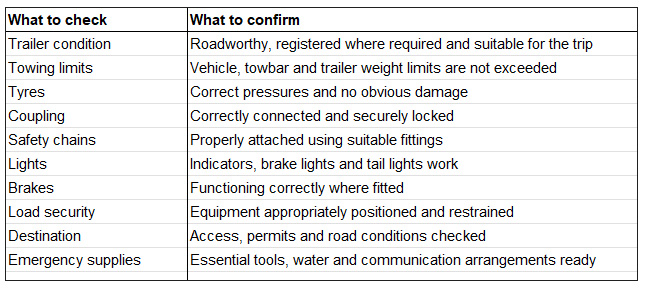
Completing these checks before departure can help you identify issues while you’re still in a position to address them.
Final Thoughts
Queensland offers some wonderful opportunities to explore the outdoors, whether you’re planning a short family camping trip or a longer adventure through regional areas.
A trailer can make transporting tents, camping gear and other bulky equipment easier, but preparing it properly is an important part of travelling safely.
From checking tyres and towing limits to securing your load and planning your route, taking a little extra time before leaving can make the entire journey more manageable.
If you’re considering a trailer for future camping or outdoor trips, exploring the different configurations available from Australian suppliers such as United Trailers can help you understand which options may suit your transport needs.
Ultimately, safe trailer towing comes down to choosing suitable equipment, maintaining it properly and driving with care.
With the right preparation, you can spend less time worrying about your trailer and more time enjoying Queensland’s great outdoors.
Source
Umme Habiba Fairose
United Trailers
Have a story to tell or news to share
Let us know by submitting a news story, an article, a review, a white paper and more …
Submit