A bushwalking safety model
Published: 8 June 2026
Overview
The Hiking Safety Systems Framework is a structured safety model that explains hiking risk as the interaction of eight interdependent functional systems. Rather than focusing on isolated skills, gear lists, or single mistakes, the framework recognises that most incidents develop when one system weakens and pressure transfers to others. Small breakdowns compound. Fatigue affects judgement. Exposure increases. Decision-making narrows. By identifying early system strain, leaders can intervene before problems escalate.
Developed by Trail Hiking Australia founder Darren Edwards specifically for Australian conditions, the framework supports clearer planning, stronger supervision, and more deliberate field judgement.
Most hiking safety advice tells you what to pack. The Hiking Safety Systems Framework (or HSFF) teaches you how to think. It gives you a way to interpret what’s happening around you and recognise when small issues are starting to combine into something more serious.
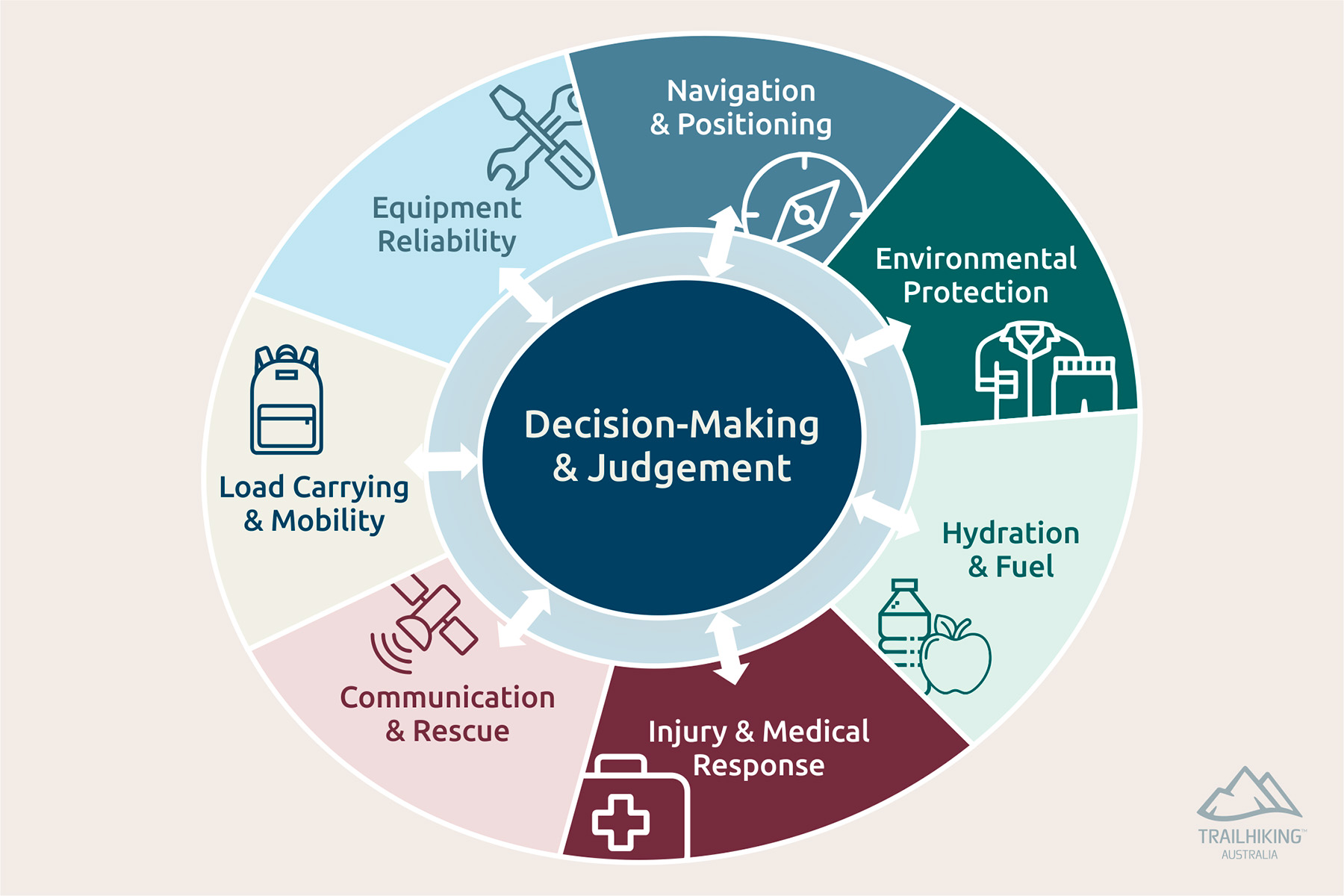
In simple terms, the framework recognises that safe hiking depends on several systems working together at the same time. Navigation, weather protection, hydration, mobility, communication, equipment and injury management all influence one another, and when one weakens, pressure shifts to the others.
Most hiking incidents begin with subtle system weaknesses rather than dramatic events, Edwards said. The framework helps hikers and leaders recognise and stabilise these weaknesses early, preventing minor issues from cascading into emergencies.
By thinking in systems rather than isolated tasks, leaders can spot early warning signs, intervene sooner, and prevent minor issues from escalating into serious problems.
The Eight Functional Systems
- Navigation & Positioning
- Environmental Protection
- Hydration & Fuel
- Load Carrying & Mobility
- Injury & Medical Response
- Communication & Rescue
- Equipment Reliability
- Decision-Making & Judgement
Decision-making integrates how all other systems perform under pressure.
Core Principle: Cascading Failure
Hiking incidents rarely begin with a dramatic event. They develop when:
Navigation drift → Time pressure
Time pressure → Fatigue
Fatigue → Reduced judgement
Reduced judgement → Increased exposure
Understanding this cascade allows early intervention.
Practical Applications
- Structured pre-trip planning
- Field-based supervision lens
- Scenario-based learning
- Post-incident debrief framework
- Professional development discussions
Designed For
- Outdoor educators
- Group leaders and trip coordinators
- TAFE and RTO outdoor programs
- Scout and Duke of Edinburgh leaders
- Bushwalking clubs
- Risk and governance committees
Want to learn more?
Interactive Hiking Safety Scenarios
Most hiking incidents don’t begin with a single mistake. They develop through a sequence of small decisions made under pressure. These scenarios put you in those moments.
Each one presents a realistic situation in Australian conditions. Work through it, make your decisions, and see how pressure builds and margin changes. There are no trick questions. The goal is not to catch you out, but to show what is worth noticing before things become critical.
The Hiking Safety Systems Foundations Course introduces a structured way of understanding how incidents actually develop on the trail.
Most hiking safety advice tells you what to pack.
This training teaches you how to think.
Most incidents don’t begin with a single mistake. They develop gradually, as pressure builds across multiple systems until there is no margin left.
This training gives you a different way to interpret what is happening around you, and to recognise when small issues are starting to combine into something more serious.
It is free. It is self-paced. And it will change how you assess risk on every hike.
Practical tools to help you plan safer, better-informed hikes
Hike planning involves more than choosing a trail. Distance, elevation, terrain, weather and daylight all influence how demanding a walk will be. These free tools support time estimation, hydration planning, track grading, equipment selection and system-based risk assessment — designed to support more informed decisions before you commit to a route.
Have a story to tell or news to share
Let us know by submitting a news story, an article, a review, a white paper and more …
Submit